01 / PERMISSIONS
Designed to observe your controls, not operate them.
Several of the APIs Verity connects to can isolate a machine, force a reboot, push a patch or start a scan. Verity asks for none of those permissions, so the access it holds cannot change anything in your estate.
02 / SEPARATION
One client's data cannot reach another's.
Tenant separation is enforced by row-level security in the database rather than by a filter somebody has to remember to write. A query that forgets its scope returns nothing. It does not return somebody else's rows.
- DatabaseRow-level security on tenant tables. An unscoped query returns an empty set rather than another organisation's data.
- CredentialsEncrypted per organisation under a key held in the environment, never in the database beside them.
- RolesExecutives, analysts and administrators see genuinely different products. An invitation grants a role in one organisation, not a key to the estate.
- AuditEntries are scoped to the organisation they concern. A switch into a client's data is recorded against that client, so they can see who came in.
- SessionsAny response that depends on who is asking is marked private. A shared cache keys on the address, not on the session.
03 / THE MODEL
Where a model is used, and where it is not.
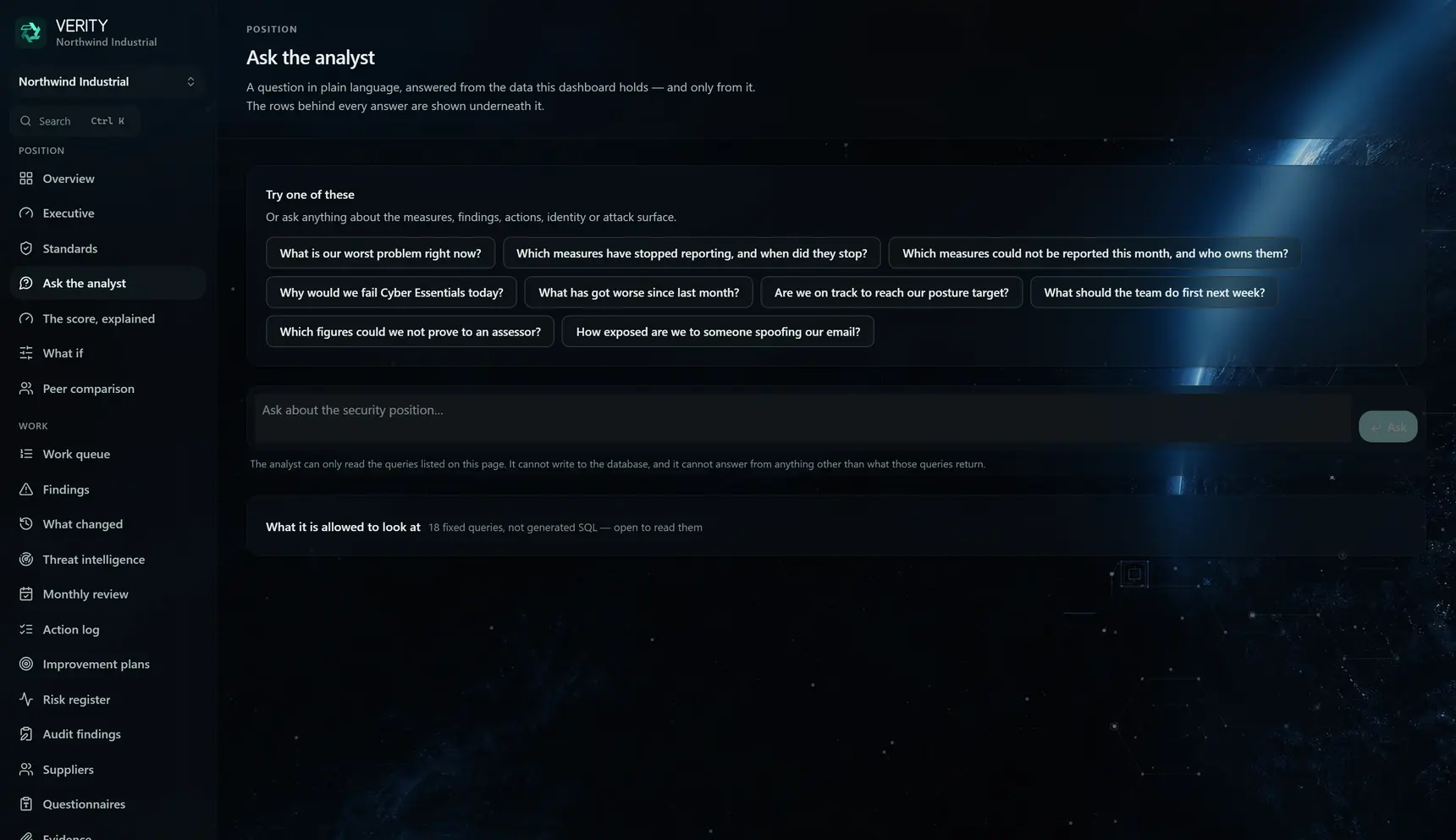
Verity uses a language model for one job: turning figures that are already computed into prose. The board narrative, the answer on the Ask screen, and the description of a spreadsheet whose columns could not be matched by name.
It computes nothing. Every score, rating, trend, projection and simulated result is arithmetic in the codebase. A model cannot move a score, close a finding, change a rating, or write anything into your record beyond a single narrative row marked as its own.
- Prose only, never a number
- A fixed query set, not generated SQL
- A stale narrative is withheld rather than printed
- Column inference is a setting each organisation turns on for itself
ASK THE AWKWARD ONE
If something here is not enough for your estate, that is a reasonable answer to reach.
We would rather you reached it now than in month three.
Request a working session